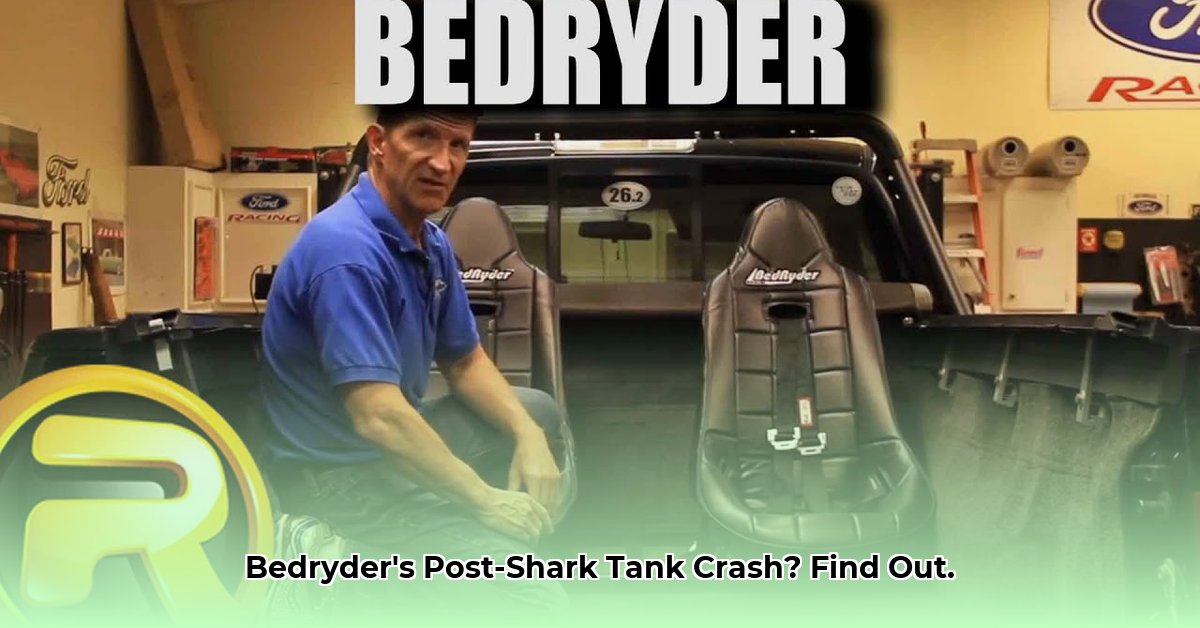
BedRyder's Post-Shark Tank Trajectory: A Case Study in Failure
BedRyder, the innovative truck bed seat showcased on Shark Tank, serves as a compelling case study in the pitfalls of entrepreneurship. While initial appearances suggested a promising venture, the company ultimately faltered, offering valuable lessons for aspiring entrepreneurs and investors alike. This analysis explores the factors contributing to BedRyder's failure, focusing on its financial performance, market viability, and the strategic decisions (or lack thereof) that ultimately led to its demise. While precise figures regarding BedRyder's net worth remain unavailable publicly, the available data paints a comprehensive picture of its shortcomings. For more on Shark Tank company net worths, see this useful resource.
Financial Performance: A Deficit of Data
Determining BedRyder's net worth post-Shark Tank proves challenging due to a lack of publicly accessible financial statements. However, available information indicates significant financial losses. The company reportedly sold approximately 800 units over its four-year lifespan. Considering a reported production cost of roughly $300 per unit and a retail price of $699, the profit margin, even with maximal sales, would have been narrow. Low sales volumes, combined with high production costs, created an unsustainable business model. This raises a critical question: Did inadequate market research and a flawed pricing strategy contribute to the company's financial woes?
Market Viability: A Missed Opportunity?
BedRyder's low sales figures—approximately 800 units over four years—suggest a significant disconnect between product offering and market demand. The limited sales data raises several crucial questions: Was the marketing strategy effectively targeted? Was pricing competitive? Did the product truly address a significant market need? The lack of detailed information on marketing spend and channels hampers a complete analysis, but the low sales figures strongly imply a failure to adequately penetrate the target market. This lack of market penetration, likely exacerbated by operational inefficiencies, strongly contributed to the company's ultimate failure.
Strategic Decisions: A Critical Assessment
Several strategic decisions, or rather, the lack thereof, appear to have significantly impacted BedRyder's trajectory. The most glaring concern centers on safety. The product faced legitimate safety concerns raised during its Shark Tank appearance regarding crashworthiness. The absence of independent safety testing and certification eroded consumer and investor confidence, proving a significant hurdle to overcome. Furthermore, BedRyder's response, or lack thereof, to these concerns remains opaque. Did they conduct further testing? Did they adjust their marketing message to address these concerns? This lack of transparency obscures a critical element of this case study.
Risk Assessment Matrix: Identifying Key Vulnerabilities
The following matrix highlights the critical risk factors that contributed to BedRyder's failure:
| Factor | Risk Level (Post-Shark Tank) | Mitigation Strategies (Hindsight) | Impact on Net Worth |
|---|---|---|---|
| Product Safety | Very High | Independent safety testing and certification, design improvements | Severely negative; eroded consumer confidence and investor interest |
| Market Viability | High | Thorough market research, targeted marketing, competitive pricing | Significantly negative; low sales led to substantial financial losses |
| Operational Efficiency | Medium | Streamlined production, improved supply chain management | Negatively impacted profitability; potentially increased costs |
| Funding Acquisition | High | Secured adequate funding before scaling, demonstrated market viability | Negative; limited capital hindered growth and marketing efforts |
Lessons Learned: Navigating the Entrepreneurial Landscape
BedRyder's story provides invaluable lessons for entrepreneurs and investors. Firstly, thorough market research is paramount. Understanding not only if there's a need for your product but also how large that market is is crucial. Secondly, prioritize safety. Rigorous testing and certification build consumer trust and mitigate potential legal and reputational risks. Finally, a robust business plan, including contingency plans for potential challenges, is essential for navigating the complexities of the marketplace. For investors, the case highlights the importance of comprehensive due diligence, extending beyond initial excitement to a rigorous assessment of all aspects of the business model.
Conclusion: The Price of Neglect
The exact net worth of BedRyder remains unknown due to a lack of public financial information. However, the available data demonstrates a clear picture of a company that failed to address key market and operational challenges. By analyzing its failures, we can learn valuable lessons regarding product safety, market viability, and strategic decision-making in the dynamic world of entrepreneurship. The case serves as a cautionary tale of the crucial role of thorough planning, risk assessment, and data-driven decision-making in achieving sustainable business success.